Monday, July 14, 2008

First Year Seminarian Prompt

Liberal Art Transition Exercise & Prompt
For Novitiate Seminarians: Their
Orientation to Humanities and Fine Arts.


SAMPLE Cognitive & Affective
Dissonance.s

Put these items in play while Joseph Campbell
urges you to follow your bliss:

“Imagination is more important
than knowledge.” Einstein.

In an interview with jailhouse reporters,
Charles Manson points to his swastika
forehead and says: “You people don’t
know where I live—places you can’t
even imagine.”

“The doctrine of hatred must be
preached, as the counteraction
of the doctrine of love, when that
pules and whines,” says Emerson:
“I shun father and mother and wife
and brother when my genius calls
me,”

Kids in class quote Nietzsche:

“It’s Beyond Good & Evil,”
Sam!

“How can we wait without idols?”
asks Auden Without representation,
without standing-for’s, signs and
symbols? Without Reasons Why?
Explanations? Blame-ations: e-
scapegoats carrying the burden
of our becausality and affect?

Do not think that I came to
bring peace on the earth;
I did not come to bring peace,
but a sword. For I came to
set a man against his father,
and a daughter against her
mother, and a daughter-in-law
against her mother-in-law; and
a man’s enemies will be the
members of his household. He
who loves father or mother
more than Me is not worthy of
Me; and he who loves son or
daughter more than Me is not
worthy of Me. And he who does
not take his cross and follow after
Me is not worthy of Me. He who
has found his life will lose it, and
he who has lost his life for My
sake will find it," says Jesus,
as far as I can tell: a gospel
in a nutshell.

“I write every day
without hope
and without
despair,” claims
Isek Dinesen.

Wait’ll they get a load of this!
says Sophocles: It’ll purgem
of fear and also pity & it’ll
separate pain from suffering
so they don’t keep collapsing,
conflating, & confusing them.
no more..

I won’t budge from under
this tree until I’m
enlightened.
Gautama.

Every kid with a laptop is the
smartest kid in class. It’s not
what you know that counts,
it’s whether you can put it
in play.

Sunday, July 13, 2008

In the shower

Some of my best thinking is done in the shower (I don't think I'm alone in this, though I am alone in the shower...). So I was thinking about how the Fine Arts and Humanities faculty and students might get together in ways other than sitting in meetings. Have some fun. Fool around. And I was thinking about how we might play out our differences.

  • Tug-of-war between Fine Arts on one side and Humanities on the other (and just what does the rope represent? Or the mud hole in the middle, for that matter?).
  • Spelling bee using each others' jargonisms.
  • Trivial Pursuit sudden-death tournament between departments leading to Division Champs--but questions can only come from outside our respective fields.
  • Three-legged sack races with a Humanities major or faculty member in the sack (so to speak) with a Fine Arts major or faculty member.
  • Dionysus vs. Apollo in a duel to the death, with commentary over loudspeakers and hords of fans, ending in a fine melee for all.

Surely other, more imaginative people can come up with better ideas than these! Anyone?

(I'm deadly serious about all this.)

A "duh!" moment

Sam, I was walking around on Sunset Mountain above the Grove Park Inn the other morning when I had a real "Well, duh!" moment, a blazingly obvious realization. Here I've been going over in my head what it really means to "turn up the difference", to hold two diametrically opposite concepts in my head at one time without letting one obliterate the other--thinking that I just didn't get it. Not a dialectical thinker, me. And then I realized that my whole attitude toward acting and theatre is exactly that. Theatre is full of promising paradoxes, but surely one of the most obvious and enduring is masks vs. faces (most famously in Diderot's "The Paradox of the Actor" but going back at least to Plato) or outside vs. inside. Maybe all the other paradoxes are just reflections of this one. For Diderot, the question was (as for many people it still is): Is it necessary for an actor to really feel the emotions being portrayed in order to give the audience an authentic, truthful experience, or can an actor just display the outward signs to do the job? In fact, if the spectator can't tell the difference, what difference does it make?

The more interesting question, for me, has to do with whether theatre is most productively approached (and taught) via form or content, movement or language, passion or gesture, ritual or narrative. Are we who do it storytellers trying weave a story with a beginning, middle, or end, or are we communally engaged in an immediate, immersive, transcendent experience, a succession of "now" moments? As directors, designers, and actors, are our most important tools the story and its characters and dramatic action, or are they the shapes, tempo, images, sounds, and other stimuli which I present to the spectator/auditor in an experiment designed to determine (among other things) whether her or his reaction to these stimuli have anything in common with my own?

The answer is, of course, yes. But these different approaches or aspects or ways of thinking about theatre are not equivalent or different ways of saying the same thing. They're different, which is not to say, of course, that they're mutually exclusive. For me, the most interesting moments happen when the differences are turned up, made to contradict each other, creating dissonance, cognative and otherwise. When all the elements complement each other, working together in harmony to support the story, say, for me the result is often boring predictability. When they don't, sometimes it's boring cacaphoney. But when they're juxtaposed with something like artistry (whatever that is), then the sparks fly. Then the outside is inside and the inside is outside, like alternating current. Then I'm electrified. Shocked. Stupfied.

So: Duh. Feel like a freshman.

Friday, July 11, 2008

re: Liberal Art from a FAH perspective

Sam, you devil, you're great! Working revising the mission statement for Theatre, trying to get somewhere with that oh-so-interesting exercise. Think we should just adopt this morning's post verbatim (illustrations and all). To say nothing of putting it in the viewbook.

Keep crying "theatre" in a crowded fire(station)--so will I, in my way.

Graham

Liberal Art from a FAH perspective

View Book Possibilities:

"Give us your children;
We will teach them how to suffer"
(aka: to stand-up-from-under, carry on
you wayward pilgrims: no whining necessary)


theatre! theatre!

Pray for Disillusionment.

& the Liberal Art:
that you might be
transferred from
illusion (literally:
“not in game”) to
ludic mode:
“in play.”

Disembarassmental Studies &
Leadership Programs


YOU: behind bars, praying for
disillusionment

Mission Impossible:
/ \
Walk on Eggs Walk on Water
(WOE) (WOW)

Got to choose yr Magistery.

Bohr-ean Economics:

“Here comes Paradox:
we must be making
progress! Ah! Contra
Addiction: now we’re
getting some where!.”

Cram people with your books,
furnish them with a constant river
of books and journals, and you may
be sure they will remember as little
as if they read none. (RWE 1848)

Theatre!
Theatre!


“All Cretans are in denial,
under illusion and pander
like a son of a gun” says
Epimenides, Cretan.

xxxooo, Presbyter

Thursday, July 10, 2008

Our Current Policy

Humanities and Fine Art


OUR CURRENT POLICY
(Polite, Policed, Political)
is based on
Denial
Illusion
Pandering.

I lifted this sentence (modified,
reconfigured, reformatted) from
my humanities colleague, Dr. K.
—out of the Asheville Citizen
Times (July 6): his fine estimation,
analysis, & recommendations re: .
energy.

Imagine:

if I could read that, construe that,
in my own terms as mere
description

no Judgment here;
no condemnation.

I’d have to rub-a-dub scrub those words:
wash that scam right out of my hair. Hose
down them negative connotations: scour
the stigma, purge & purify till they were
sweet as a baby’s but squeaky clean:

DENIAL? ...sure, of course.
ILLUSION? well, duh!
PANDERING?
how could it
be otherwise—you got a
problem
with that?


Wouldn’t that make a difference that
made a difference in my converse- action?
Could I talk with any body? Walk?

Ingredients

To make some Describe Mode:
you need Brillo, Old Dutch Cleanser
& old fashioned Elbow Grease


I’m here to Wash Off the
“damned moral sense”
so as to inaugurate
Pure Aesthetics
for crying out loud:
“the view”
a fine art!

@@@@


IT’s A GOOD THING
our energy crisis.

Wrestling, wrangling, writhing, wretched: me
caught in Mother Earth’s Economics Summit,
damnit —her version of sustainability imposing
itself on my own received traditions & I got to
be saying: what? what the…? what the hell?
UNCLE!
UNCLE!.


That’s me in denial;
That’s me in illusion—
pandering like a son of a gun:
abusing my religion..
Gnosis
“Men go through the world each musing
on a great fable, dramatically pictured
and rehearsed before him. If you speak to
man, he turns his eyes from his own scene,
slower or faster endeavors to comprehend
what you say. When you have done speaking,
he returns to his private music.
…All parties: in a private box with the
whole play performed before himself
solus. (RWE)

The Narcissus who knows he’s a narcissist
is no longer narcissistic in the common sense,
well: narcissistic, sure, but not Narcissistic.

Sisyphus knowing better is not the Sisyphus
who doesn’t—but he’s still pushing his stone.

Procrustean hospitality is always hostile even
after I know it & will still cut & stretch
accordingly but no longer not that
innocent, knowing better.

Cement of Inertia. –Is it not a rare contrivance
that lodged the due inertia in every creature,
the
conserving, resisting energy, the anger
at being
waked or changed? (RWE)

I used to not know I was deaf, dumb and blind.
Now I do: all 3. I didn’t know I was solipsistic,
but I do now: solipsist like any thing. I don’t
deny I deny I’m in denial, damnit: under an
illusion thinking I’m ludic. I admit it.

Panderer? But of course—pimp,
procurer, catering to my
lower tastes

Altogether independent of the intellectual
force in each is the pride of opinion, the
security that we are right. Not the feeblest
granddame, not a mowing idiot, but uses
what spark of perception and faculty is left,
to chuckle and triumph over the absurdities
of all the rest. Difference from me is the
measure of absurdity. Not one has a misgiving
of being wrong… (RWE Sept, 1845)

xxxooo, Presbyter

Wednesday, July 9, 2008

peace peace & justice


Political Correctness

Both Humanities and Fine Arts
are enormously invested in the
inertia of Political Correctness:
greening sustainability environ-
mental diversity social justice
issues the economy of course
and those who suffer wild fire
and flood, earthquake, rising
gas prices and war: it’s a brick
house

Any one against these concerns
or indifferent were it possible
would be politically incorrect &
might as well be hauling Isaac up
the hill to cut his throat or trying
to fix holes in the roof during the
monsoon for all the sympathy
she’d be begetting in her own
home town. Mother Superior.

Just describing here—not judging.

Miser

I have to give up what I can’t let
go of: my Judgment & good &
evil addiction, have to let it be
but I can not: my Judgment:
not judgment but
Judgment.

Judgment on the one hand and
judgment on the other. One is a
royal pain. The other: essence.

I can draw the distinction, even
consider the relationship; but I
can’t let go, or suspend: no I
can't back down though I
can talk about it. It’s a
brick house.


inertial sustainability:
an ecologic

Wednesday, July 2, 2008

Kinds of Conversation & Not Just a Matter of Degree.

Dear Graham,

Talking across the Curriculum about Liberal
Education (the business we’re in) is a radically
different conversation than talking within a
discipline (physics talk, anthropology talk,
engmajor talk…): sub-ordinate to the whole
collegiate enterprise, don’t you agree?

A horse of another color: a conversation on a
different hierarchal level— like meta-linguistics
is to linguistics, say. Or meta-physics to physics.
Like the “philosophy” in our PhDegrees is to
whatever-it-is we studied in grad school: all of
us philosophers here regardless of our “majors.”

Our mutual love of Sophia!

We could turn that up and say—that’s our common
language, not be deterred in our universalism by the
specialization of Physics Photos of the Week or Kahl’s
quantum savvy, or your culture of fine art, plays,
sculpture and demonstration of both representational
& non-representational genius etc.

E Pluribus Unum.

And talking about administrative & infra-structural
considerations: house-keeping (eco-logical, economical)
concerns—faculty-body issues, assessment & accreditation
across curriculum & staff, instrumental and utilitarian
applications, load, contract and contact hours, calendar
considerations (released time for student research
presentations, & for examination week: how many
weeks constitute a semester…): that’s still another kind
of conversation and not just a matter of degree. .

3 kinds of talk, right there:

liberal education
III.meta-disciplinary (the whole & holy)
II.disciplinary (diversity: difference)
I. housekeeping (the eco-system)
bottom-line common sense

Sort of like:


Can’t really have the top-of-the-pyramid conversation
going on it seems until the bottom-line issues are
satisfied, secured, nailed down. Our Fundamental
Concerns tend to hegemonize the whole deal.

Just differentiating here for the sake of argument.
Anyone can improve my terms and images. Easy
to collapse, conflate, & confuse the conversation.

I can’t talk-the-talk of the disciplines & am intimidated
by diverse expertise my abysmal ignorance & forget we’ve
got a common tongue over all we could be turning up
—putting in play. Could call it The Liberal Art Conversation,
as opposed to the liberal arts.

Always a matter of coming to shared terms again and again.
Rolling our own holy smokes, I say. Unless we just use/abuse
the ones already on the shelf: shrink-wrapped, packaged and
delivered. Old Gold.

xxxooo, Sam

Tuesday, July 1, 2008

The Ideal of the University

I'm reading Robert Paul Wolff's The Ideal of the University and I find it fascinating. I won't write a review or essay here--just a couple of quotations--but I'm wondering if others have read it and what kind of reputation Wolff has (exposing my ignorance). It was written in '69 (he was at Columbia in '68 for all the fun) and this edition has a "new" intro written in '92. Still seems quite relevant to me, to use a word from that era.

In '92 introduction, he says (referring to the inevitable disappointment that follows every revolution, and drawing on Marcuse):
". . . the great works of art, literature, philosophy, and music of our cultural tradition plan an essential, and rather surprising, role. Regardles of their manifest content and apparent purpose, these works, which we customarily consider the appropriate content of a liberal education, play a continuingly subversive role. They keep alive, in powerful and covert ways, the fantasies of gratification, the promise of happiness, the anger at necessary repression, on which radical political action feeds."

Elsewhere::

"But when administrators attempt to apply the principle of efficiency to the operation of their institutions, they have a natural tendency to measure efficiency in terms of whatever they can quantify, rather than measuring it in terms of what is genuinely related to the real goals or values of the institution."

Well, it's hard to argue with that. But it bears thinking about.

Arguing that administrative decisions should be made subjectively, not objectively:
"Ironically, paradoxically, there are some human activities in which subjectivity is more efficient than objectivity, in which calculation kills and instinct inspires. Art and love are notoriously of such a nature. I believe that education is also."

Sam?

He also argues that grading is commonly associated with three activities: criticism, evaluation, and ranking. And says that evaluation and ranking--where "grading" lies--are extrinsic to education proper. Of course, he also says, "It should be obvious that there is no easy way to disentangle education from the essentially extraneous processes of evaluation and rankng."

I'm about to begin the section which asks, "Why Should a University Be Governed At All?" Interesting stuff.

Monday, June 30, 2008

working out salvation in fear & trembling


OPPOSITION

But look:

Don't romanticize us fine arts folk.
At least in theatre the temptation is
always strong to sentimentalize, to
equate, to equivocate, to blend and
smooth and play it safe,

rather than to confront, to juxtapose,
to take to extremes, to push the
contradictions as far as they can go,
to REALLY make fools of
ourselves. G.P____

While there is much desire to learn
there of necessity will be much
arguing, much writing, many
opinions; for opinion in
good men is but
knowledge in
the making.

Under these fantastic terrors of sect
and schism—fear of dissent, differences
in viewpoint—we wrong the earnest
and zealous thirst after knowledge
and understanding which God hath
stirred up in this city. Milton, Areopagitica

Dear Graham,

I’m juxtaposing you and Milton and turning
up the hostile, genuine & legitimate opposition
between the need for much arguing, much writing,
many opinions on the one hand and on the other
hand: terrors of sect and schism: fear of dissent,
differences in view point—& subsequent necessity
for polite if not policed political correctness.

I play to argue with myself, too—constant game of
scissors, rock, & paper. I’m wining & losing like
anything.

Representation

You guys in Fine Arts stand-for the Makers.

Us Humanities people: we stand-for the
Givers and Takers.

Folks in Hamill: guess we could call them
the Shakers.

You can improve my terms.v It’s the distinctions I
would turn way up. Once characterized, we can see
all 3 aspects as integral to each discipline.

This is cerebral modeling, not political. Every major
has it’s Mohammed-to-Howard ratios, say. Or every
disciple & practitioner. More or less Mohammed;
more or less Howard: that would be an assessment
worth assessing. Pie Charts across the Curriculum.

The Regulator

The Stream of a Common Language called COURSE
eclipses the diversity of our dialect differences & it’s
this pervasive permeate Structure of Hire Education
that collapses schola into assembly-line-study so it
feels like All The Same: syllabic agenda-driven textual
harassing quiz & exam regulating grade-gun corralling:
forcing the issue with make-it-up research & well-
documented paper-writing whether down South with the
Hamillians or up North with Graham and the Fine Artists.
It’s all One & the Same Old Same Old.

(Graham, what I just said is nonsense if no senseat all to
you swimmers swimming in the medium of industrialized
education all your so-called lives, you got no comparison,
might as well ask a fish to define wet let alone dry: it’d take
something like immaculate conception or else get hooked
and hauled into the canoe to flip-flop in air for five minutes
for my kind of foolishness to register. I don’t blame
you none at all. Ludicrous.)

.

xxxooo

Sunday, June 29, 2008

Sam,

Thanks for the words. Yes. Sounds right. Helpful. Thinking about Tom Stoppard saying he writes plays so he can argue with himself. But look: Don't romanticise us fine arts folk. At least in theatre the temptation is always strong to sentimentalize, to equate, to equivocate, to blend and smooth and play it safe, rather than to confront, to juxtapose, to take to extremes, to push the contradictions as far as they can go, to REALLY make fools of ourselves. (One reason we still don't get Brecht.) And we--make that I--give into the the temptation all the time. I can hide just as well as anyone--I can hide behind my art and never, ever sting like a bee.

Keep it up.

Graham

FAH! & JENSENSUALISM &the Hard Sciences


Dear Graham,

How to think about the relationship
between FAH and Social Sciences
and Natural Sciences CREATIVELY?

What do I know?

Unilaterally, I’m always “masturbating a glitter”
as Sylvia Plath put it.

I would say:

turn up the DIFFERENCES between the 3
—way up: way, way up, way, way, way up--
ignoring the clamor of the crowd to hook-up
& connect & just-get-along. We celebrate
Diversity, yes?

Then characterize:

Freddy FAH, Sally Social Sighence
and Harry Hurry Hard walk into
a bar
together…

That’s the scene.
Improvise.

Let it be a fight-club, let it play itself without
any ultimate winners & losers or dominant
pair-o-dimes: a sustainable conflict going
on & on wrangling and wrestling and
always waiting for Godot.

See what transpires in the way of Relationship
that don't rub the edges off the differences or
eclipse the battle royale.The devil’s in the
differences, true? Forever more. Got to
be room for her in the inn.

My delight that you have taken-on this administrative
task (among other things) is because you & your fine
arts colleagues are primarily CONSERVATORY-based
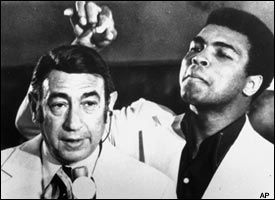
in VALUE: you guys are the Mohammad Ali’s of of WWC.

The Makers

The rest of us ACADEMICS =
the Howard Cosells: Give & Takers. Emendators.


You do the math.

Got to love each other & not collapse, conflate,
or confuse the space between, true?

Maybe anyone can improve my terms and
images. We could argue.

College!

xxxooo, Sam

Friday, June 27, 2008

Confession

I know this blog is limited to us FAH! faculty, but I've taken the liberty of inviting the other Division Chairs onto it: Ben Feinberg, Social Sciences; Paul Bartels, Nat. Sciences; Chris Nugent, Library. Hey, Ben started it! He let me onto Jensensual Relations, the Social Sciences Div. blog.
Graham

Is Environmental Studies the Walmart of Warren Wilson?

The title of this post--and, in fact, the post itself--is not my own. In an act of shameless appropriation, Ben Feinberg, Chair of the Social Sciences Division, has started a blog for his division called "Jensenual Relations" (great name, I must admit). On that blog, he posted a terrific examination of the relative "weight" of different departments and divisions, starting with the question of the apparent dominance of Environmental Studies over the college curriculum. With his kind permission, I've reposted it here. I think it gives us much food for thought regarding our own division and how FAH might, as Ben says, "claim some of that attention.". I offer a comment of my own, and I invite others to do the same.


Is Environmental Studies the Walmart of Warren Wilson?

We sometimes hear the statement that ENS is "a third of the college." There are many ways to divide up the college, and I am not sure what method is used to come up with this statistic, which has taken on a certain mythical status. I don't, at the moment, have access to the majors of our current or graduated students, so it could be that one third of them are ENS majors.

ENS certainly doesn't provide one-third of the student credits. Last fall (and there may be built-in differences between fall and spring semesters), ENS was the largest single provider of credits, accounting for 8.0% of college. Biology and Chemistry, two programs that provide many credits to the ENS major, accounted for another 5.5% and 6.6%, respectively. In fact, the breakdown by Division (with the top three departments within each division) looked like this:

Arts and Humanities 33.7%
HPS 6.7%, ENG 6.4%, ART 6.1%

Natural Sciences 26.8%
ENS 8.0%, CHM 6.6%, BIO 5.5%

Social Sciences 25.5%
SOC/ANT 6.3%, PSY 4.7%, ODL 3.6%

FRS, Comp I, and PED: 13.3%

Which for some reason doesn't quite add up to 100%. But its close.

(We may wish to remember that these numbers are influenced by the General Education requirements, which ensure that every student take two Natural Sciences courses [Math and Science], three Arts and Humanities [AES, HPS, LIT] and only one Social Science course while two other general education requirements can be met by courses in more than one division, but are most often met in Arts and Humanities [GI and PHI/REL].)

Anyway, ENS is the single largest program, perhaps because the great majority of Natural Science majors choose this major, and that accounts for about a third of the school. This may make it seem disproportionately significant - Arts and Humanities and Social Science programs may seem less visible because students in these areas are divided up into a number of smaller majors.

So, because of its prominence within Natural Sciences, ENS appears like the big kid on the block. Does this make it like Walmart, an entity that uses its massive size as an advantage to bully the smaller mom and pop stores?

We can see one example of this analogy at the beginning of the year, when we all gather in Canon behind tables promoting our majors. We sit and wait for students to wander by with our handouts and balloons and, in the case of Chemistry, our explosions. Suddenly there is an announcement: "All vendors that wish to sell to Walmart, immediately gather at the far end of the room." There, new students are told that they must take such-and-such course right away. It feels a little like the rest of us are being bullied. ENS also requires more credits to graduate than most other majors. And its Intro course usurps the role of languages at the school - students strangely satisfy our language (language and global issues) requirement by taking Intro to ENS, pushing students out of another possible path into the Humanities or Social Sciences. Last year, two new faculty positions were summarily granted to the behemoth without any campus-wide discussion. Could this happen without the big-box pressure?

Our ENS program appears to be thriving, and it not only provides students a great education in the natural sciences, but has helped create a niche for Warren Wilson that helps us attract new students and stay strong. It also directs attention on the major challenge facing us as humans who are busy making our planet uninhabitable. The strength of this program benefits us all.

But one could argue that ENS has also been the vehicle for the Natural Sciences to mold a united front which has given them added strength to push for resources and new faculty positions, and to become, for many the face of our academic program. How can the Social Sciences, with our numerous disparate programs, claim some of this attention?

There are a few possible answers -
1- uniting into a division should help. Perhaps we can be Costco.
2- Recognizing our place and our programs, and their place in the "sustainability" rhetoric of the college. Environmental Studies faculty recognize the importance of sustainability beyond the natural science and environmental issues their department focuses on - the environmental issues and inextricably linked to issues of social justice and economic inequality, for example. Over the years, there have been occasional efforts to make the ENS major more truly interdisciplinary, by incorporating Humanities and Social Science courses. At times this appears like tokenism, and when ENS added new faculty this year, it did so in Chemistry and Biology, not in non-science areas. But the Social Science division already has a counterpart to ENS - an interdisciplinary major that focuses broadly on global issues of sustainability. This is the Global Studies major. This major doesn't get nearly the attention of ENS, but it consistently attracts many majors, many of whom began their careers as ENS majors. If the college, and the Social Science division, recognize the role of Global Studies as a complement to the natural science ENS major - an equal component of the college's commitment to the environment and global sustainability - we would raise the profile of the Social Science academic program in ways that would benefit us all.

Wednesday, June 25, 2008

Does a Crow Try to Fly to Mt Mitchell ("I think I can I think I can")

On Inter, Intra, & Extra
Textual, Contexual &
Consensual Relations
among Faculties

“I think he has seen,
as no other in our time,
how inexhaustible a mine
is the language of Conversation.”

Emerson on Carlyle

“Professor F______ brought up the idea
of opening the SocSci blog to the faculty
to read--but only those in his division can
make posts or comments.

I like that idea as opposed to a completely
closed conversation, but I wonder what
others may think. Hello?” (‘Fesser P____.)

We understand nothing; our ignorance is abysmal,
the over-hanging immensity staggers us, whither
we go, what we do, who we are, we cannot even
so much as guess. We stagger and grope.

Why would I or faculty-at-large (committee of whole)
want to read stuff we weren’t allowed to respond to?
Comment on? Take issue with? Put in play?
What’s the point? To take notes?

Like listening to someone lecture
who insists no no no questions—
please. Let me finish.

“Yes, Yes, that’s a conversation we need
to have--but notnow.”

Man is insular and cannot be touched.
Every man is an infinitely repellent orb,
and holds his individual being on that
condition.

Seal IT off completely—the cross-disciplinary
fertilization-bounce-of-analogy-begging-to-
differentiate-draw-distinctions-merely-for-
the-sake-of-argument-&-anecdote-&-
local-food for thought going on
inside the new Jensensual
Relations and FAH!
blogs…

Or let it hang out.
Kick the can.

IT’s the difference between
laissez-fair & lasso fair, between
upside down flamingo & hedgehog
croquet and the hard balls & mallets
kind. Chose your magistery.

“A believer in Unity,
a seer of Unity,
I yet behold two…

Cannot I conceive
the Universe without
a contradiction?”

xxxooo, R.Waldo Emerson (Eng.Major)

Tuesday, June 24, 2008

I'll keep trying, Sam

Well, after setting up this blog and noticing that it hasn't gotten much play, I've neglected it. But Sam is bringing me back to to myself with his last couple of posts. And Ben Feinberg, to, with his "Jensensual Relations" Social Science Div blog (inspired by me, I must boast). Ben keeps plugging away with terrific posts--get some replies, too. So I'll keep trying.

Ben brought up the idea of opening the SocSci blog to the faculty to read--but only those in his division can make posts or comments. I like that idea as opposed to a completely closed conversation, but I wonder what others may think. Hello? Anybody there? If I can figure out how to do it, do you think it's better to let others observe any conversation that may happen here, or is it better to keep the whole thing private (limited to FAH faculty)? I like the idea of openness but what are the drawbacks? Of course, the question is relevent only if this blog becomes a forum for conversation about FAH-related issues. If it does, then would such a conversation be inhibited if we knew that "outsiders" (yikes!) were able to read it? Maybe I'll attach a poll to the blog.

Sam's recent post, "Sustainable Converse-action," is inspiring. Of course, he's been trying to promote such a conversation on faculty-l for years now--I'm in awe of his perseverance. It may be that email conversations work better than blogs like this--not really important (unless it says something important about the confidentiality aspect)--but I sure hope that we can enrich the opportunities for such conversation one way or another. Well, but multiplying the ways, I guess. As one who doesn't make it to Gladfelter often enough, that would be good.

Thinking about Ben's "Jensenual Relations" blog: The title is great, and alludes to the fact that most of the Social Science division (but not all) is housed in the asbestos-scented garden of earthly delights that is Jensen. Not true of FAH. True of H but not FA. This geographical split may indicate the oddity of merging Fine Arts with Humanities, or at least accentuate our possible distance from each other. True? If that's the case, would virtual conversation help?

I want to post here regularly as a way of thinking out loud about issues--regardless of whether anyone is reading at the moment--and soliciting reactions. Email is better for important info out to chairs and faculty, and ensuing email conversations will be good, too.

Topics to write about on future posts:
  • more on reactions to course evaluations (especially online version);
  • how "sustainablilty" relates to FAH and if answering that question will lead to more visibility and clout for division;
  • program reviews: purpose and timing
  • more on ARSE: process and instrument
  • Ben F's "ENS as Walmart" question

Monday, June 23, 2008

Sustainable Converse-action

The New Media is the Message,
not the message.

Dear College,

In the library the other day, Ben Feinberg showed
me his newly installed Social Sciences Blog with
the same enthusiasm as Graham when he established
FAH! at the beginning of summer, for Fine Arts and
Humanities exchange.

Possibilities for collegial conversation across &
within intra-disciplines! Talk-going-on that is not
limited to 4:00 meetings, lunchroom & hallway
occasionals, professional conferences & refereed
publications, slam poetry events, after-performance
round-tables, book-club meetings, team-teaching
debates, graduation addresses, deans conferences
and self-evaluation reports, staff forums and
faculty body conventions:

But rather: the possibilities of The New Media
Post Literate and Neo Oral, kin to cell-phone and
text messaging and of course e-mail: reviving the
the earlier tradition of Bell Letters where information
and knowledge and questions and interests and
concerns were communicated in non-thesis driven
digressive, genial conversational exchanges—back
& forth like talk but with distance & remove:
detachment & yet connection..

One inconvenience I sometimes experienced
in so small a house, the difficulty of getting
to a sufficient distance from my guest when
we began to utter the big thoughts in
big words.


You want room for your thoughts to get into
sailing trim, and run a course or two before
they make their port. The bullet of your
thought must have overcome its lateral and
ricochet motion, and fallen into its last and
steady course, before it reaches the ear of
the hearer, else it may plough out again
through the side of his head.

Also, our sentences wanted room to unfold and
form their columns in the interval. Individuals,
like nations, must have broad and natural boundaries,
even a neutral ground, between them. I have found
it a singular luxury to talk across the pond to a
companion on the opposite side.

In my house we
were so near that we could
not begin to hear—we
could not speak low enough
to be heard, as when you
throw two stones into
calm water so near that they
break each other's
undulations...As the conversation
began to assume
a loftier and grander tone, we
gradually shoved
our chairs further apart till they
touched the wall
in opposite corners, and then
commonly there was
not room enough..
. (H.D. Thoreau)

Social Science is a closed blog like FAH! (invitation only:
takes some fooling around with google & gmail and
passwords to participate). "We'll see how it goes, closed,"
said Ben. Keep it in the family for now. Graham, too: same.

Like us (fine artists & humanitarians): there was an initial
flurry, Ben said, and then not so much; and he & I talked
low in the library about what IT meant and what IT took to
get into IT and how-IT-is that the MEDIA we swim in now is
radically different than what-IT-was and how IT might
ultimately impact school & schooling and study and scholarship
and research and publications and academic probation and
footnoting, plagiarism of course (intellectual property) and
retention and attendance policies and whether we as colleagues
were shy or lazy or indifferent or not rewarded for IT or not
tuned-in to IT’s possibilities (the media IS the instant messaging
of thought and insight and query and quip and quest and
edification--emergence of local food-for-thought and
foundation for our own intellective and affective sparking.

Anthropologically speaking, I bet IT takes a collective Mind-Set
(shared attitude, atmosphere) for this kind of collaborative and
conversational genius to grow as a local garden of delight, say.

Or it has to be "cool," maybe. Like some new sport. OR else
like old-time back porch jamming: plink plank & everyone's an
instrument in the band & we all get better and good by playing.
Or it'll come into fashion--like hair cuts or tattoos, small cars.
The Chronicle of Hire Education will begin plugging this kind of
home-groan activity and then IT'll be ok to participate.

Something like that. I need help, as usual, to make sense of this.
IT's not a matter of reason and logic. More of an
ENVIRONMENTAL ISSUE: what IT takes to
put us in play together: our 3 divisions,
within and without.

I’m sure anyone can improve these terms and maybe help
sustain this conversation—either in our inter-disciplinary
blogs or (better) across the curriculum on FacultyL.
What prevents? & Why? I’m just asking. Or
what’s a college for these days?

xxxooo, Sam
Wednesday, June 11, 2008

Good question, Ron. I take too much for granted, given that I'm asking the question of ALL faculty, not just full-timers. Also, given that a related question--and one that will be answered soon, I think, one way or another, is this: Should part-time and adjunct faculty get some kind of performance review, or at least be required to do a self-evaluation as do full-timers? What kind of oversight is necessary or desirable?

Anyway, here's a way to answer your question. You can download the ARSE form by going to the "inside" webpage (https://www.warren-wilson.edu/internal/), find the "For faculty and staff" box on the lower right side, click on "Academic Affairs", then look for the list of links on the left side of the page. Whoa! I just discovered that there a link for "Part Time Faculty Annual Report"! Imagine my surprise--shows you what I know. Anyway, you can download that one, and also download the full-time faculty ARSE form.

The fact that I didn't even know about the part-time report show both that I'm a lousy department chair and that there's very little guidance about these things. Interesting.

Hope this helps the discussion. Back to my own ARSE now!

Graham

My Annual Dean's Report

Vita at WWC

dorm painter diesel disc-er (spring field prep) asst
fire "chief" eng dept chair tennis coach NEH summer
seminar in composition athletic dept secy chair task
force for curriculum reform dean of college and
academics Lily Foundation Colorado Springs Seminar
Curriculum Development NEH Proposal Reader &
Evaluator. St Louis Workshop Presenter (work &
academics) Carnegie Mellon Summer Program for
Academic Leadership NEH summer seminary in
Literary Criticism & Theory freshman seminar coordinator
writing competency coordinator director of humanities
major local fool & self-designated fundamentalist.

Used to be the annual Dean's Report was intended
as self-study and reflection: how can I be a better
teacher if not person. These were the days of "group
dynamics." Over time (and with Spence McWilliams
insistence) it became an "instrument"--an annual
resume-update and tool for extended tenure
assessment and evaluation.

This is the difference (attitude, outlook) between
AMATEURISM and PROFESSIONALISM.

While I know there are good things to be said about
professionalism and that no one stands up in forum
to say "well, can't we be a little bit more amateurish
about this" -- I have always hated the loss of our
initial muddling-thru: what the...what the hell... spirit
as we seemed inexorably destined to become a not
so jolly Green Documental, nail-it-all-down,
litgatigation-avoidance professional place--
nothing less then the terminally degreed
need apply and everyone's a doctor.

Anyone can improve my terms and images.

I lost the zip drive that had a chunk of my Annual Dean's
Report yesterday--left it in the library computer where
I'm working these days while new windows are installed
in Jensen.

So I'm starting over from scratch. From scratch is a
good place for me to begin again, seeing as it's become
a fundamental aspect of my pedagogy. Begin again and
again finagin! Each class in a sense, starts up from old
scratch.

Origins are uncanny: mostly I can barely conceive of
their conception--every move I make, step taken,
word uttered IS a beginning seeing as it seems and
feels like a continuity, in the middle of things like
stepping hard in a puddle of water,

Origins, originating, generation begetting, starting
from scratch, zero-basing, tabula erasing, re-inventing
wheels--in the same category with Be Here Now which
is impossible because I am carried along by my agenda.

Every class a new beginning. Redundantly. I often
ask students: which would be easier to determine--
the beginning of the universe or the first time someone
(probably female: me, stereotyping for the sake of
argument) tied a neckerchief around a dog's neck?

Think about it. We can vote.
xxxooo, Sam
(to be continued)

But first... what is it, and what is it for?

As a newbie, and not officially a permanent member of the faculty, it is my role to ask, "What is an Annual Report (and Self-Evaluation), really?"

Maybe if you can tell me what it is assumed to be, it will begin to define and change itself toward something that is less of a pain in the ... as David monikered.